TRENDS 2026 Which social media platform?

TikTok is no longer just a platform for young people, Instagram is under intense competitive pressure, and Facebook has been declared dead countless times – but it remains relevant. Since very few can be present everywhere, many are asking themselves: Where can we achieve the greatest impact with our resources?
For non-profits, social media is much more than a marketing channel: it is a tool for public relations, mobilisation, fundraising, education and political influence. At the same time, time, budget and personnel are often limited. This makes it all the more important to consciously select the right platforms and use them strategically. In addition to reaching specific target groups and the type of content, political issues are also becoming increasingly important: since Elon Musk's takeover of Twitter, at the latest, presence on certain channels has also become a question of attitude.
Instagram – Visibility, emotion and community
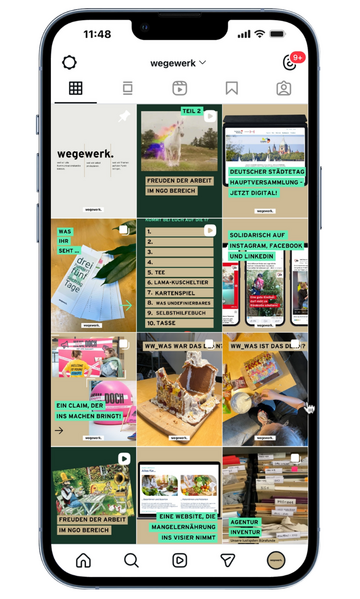
Instagram remains one of the most widely used platforms with an active and broad audience. To keep up with TikTok, the algorithm primarily pushes video content (Reels), supplemented by carousel posts and stories.
Which non-profit organisations is Instagram suitable for?
Instagram is particularly suitable if your work can be presented visually and you can convey complex topics in an understandable and emotional way. Competition is fierce – successful content offers added value and encourages sharing and saving.
TikTok
Reach, education and activation
With TikTok, the question now is rather who is not represented here (except for data protection critics – for obvious reasons). The days of pure dance videos are over: everything from educational work and activism to political debates takes place here. For non-profits in 2026, TikTok is one of the most effective platforms for reaching young target groups, raising awareness of social issues and providing low-threshold educational work. The big advantage: the algorithm is content-driven. Every single video has the chance to reach a lot of people – even without a large number of followers. This makes TikTok particularly exciting for campaigns and awareness work.
Which non-profit organisations is TikTok suitable for?
For non-profits that are willing to try new formats, simplify content and present themselves authentically. TikTok is a creative playground that rewards courage – but demands authenticity and tact.
Mastodon / Bluesky / Threads / X
Attitude, discourse and expertise
These so-called microblogging platforms are particularly relevant for non-profit organisations when it comes to political communication, classification and professional positioning. Their reach is smaller than on Instagram or TikTok, but the exchange is often deeper and more direct.
Which non-profits are Mastodon, Bluesky, Threads & X suitable for?
For non-profit organisations that want to share expert knowledge, political demands or social analyses and engage in public discourse.
X / Twitter
Twitter, renamed by its new owner Elon Musk, is the oldest microblogging service, which, despite massive user churn in 2025, still has around 560 million monthly users worldwide. Due to a conflict of values (hate and disinformation are not sufficiently restricted, systemic polarisation, disrespect towards employees and communities), X is generally considered a toxic environment, except in circles of the New Right. We currently do not recommend that any customers operate on X (formerly Twitter). If you were already active there, there are various options for dealing with the content; here are some recommendations from 2024.
Threads
With around 400 monthly active users worldwide, Threads is currently the most relevant alternative to X. In terms of daily user numbers, Threads has reportedly even overtaken Twitter in the USA. Threads is a little more civilised than X, but here too (as with Instagram and Facebook), you are on the channel of a tech billionaire, only in this case his name is Marc Zuckerberg.
Bluesky
Bluesky works very similarly to Twitter, but is a non-profit organisation. In November 2025, the global community had over 40 million users worldwide. Bluesky theoretically works in a decentralised manner, but in reality most users are registered on the central bsky.social server.
Mastodon
Mastodon offers the most consistent differentiation. This open-source solution relies consistently on decentralised structures, which is why Mastodon is also somewhat less intuitive to use. Here, the choice of a Mastodon server can already be a political statement. With currently around 10 million users worldwide, the community is the smallest, but in Germany the number of users is greater than that of Bluesky. Mastodon users are also above average in terms of activity.
Credibility, partnerships and impact communication
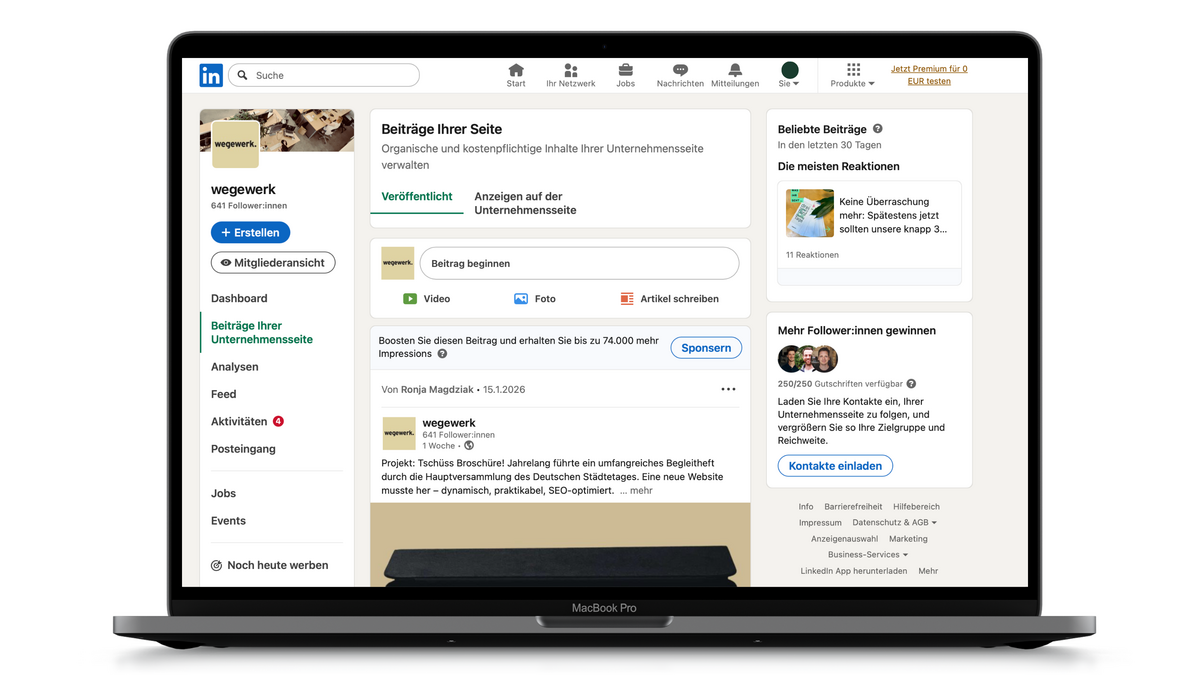
LinkedIn is becoming increasingly important for non-profits – especially for collaborations, funding, employer branding and impact communication. Content with technical depth and a personal perspective achieves high interaction.
LinkedIn is a more serious environment – but that doesn't mean there's no room for humour. The key factors are content, storytelling and insights into your work. Videos are also becoming increasingly important here.
Which non-profits is LinkedIn suitable for?
If you want to reach partners, sponsors, professionals or volunteers and demonstrate your impact transparently, LinkedIn is an important channel.
Existing community and older target groups
Facebook continues to play a role for many non-profits, especially for maintaining existing communities or for target groups over 40. Even though Facebook is no longer growing, it is still one of the largest platforms. The users who are active here have stayed to stay and continue to interact regularly.
Which non-profits is Facebook suitable for?
If you already have an active community here, you should not neglect it and continue to provide it with good content (relevant, interesting, appropriate graphics). If you want to specifically reach older supporters, donors or volunteers, this could still be your platform.
YouTube
Depth, visibility and long-term impact
YouTube is not a short-term reach channel for non-profits, but rather a platform for depth, classification and sustainability. Content does not disappear in the feed here, but remains findable in the long term – via search, recommendations and external links.
Which non-profits is YouTube suitable for?
YouTube is particularly suitable for non-profit organisations for explanatory videos, background formats, project documentation or longer interviews. Educational and awareness-raising work can also be implemented well and with comparatively few barriers here. Setting up a channel is time-consuming, but can pay off in the long term – especially if content is used multiple times (website, newsletter, social media).
Important: YouTube only works with continuity. Individual videos without a clear line quickly fizzle out. Anyone who uses YouTube should do so consciously – with realistic expectations.
WhatsApp, Snapchat, Twitch and Discord
Community instead of reach
Whether cross-generational like WhatsApp or more focused on young target groups like Snapchat, Discord and Twitch: push rather than pull usually applies here. People consciously join channels, groups or servers and expect relevant, personalised content.
Which non-profits are these channels suitable for?
These platforms are particularly valuable for NGOs with an existing community. Supporters, volunteers or activists who follow you here can be more closely connected, informed more quickly and mobilised in a more targeted manner.
At the same time, it is difficult to reach new target groups here. Visibility hardly ever happens by chance. If you want to grow, you have to work in a targeted manner – for example, through collaborations with creators, influencers or paid advertising.
These platforms are particularly worthwhile if you already have an engaged community or the capacity to build a permanent space for exchange in the long term.
Conclusion
Dancing on all platforms at once and only half-heartedly playing out your content is not an option, if only because of the diversity described here, which shows no sign of diminishing. It's better to focus on a maximum of three channels and use them properly. This means: appropriate tone and formats as well as active community management (keyword: social). Don't treat social media as just another advertising channel, but as a separate, self-contained world in which you operate.
The extent to which you can also use content developed for a specific channel in related channels under certain circumstances (e.g. short posts for Bluesky also on Mastodon or Reels for TikTok also on Insta) and the role that suitable cross-posting services play in this is a complex topic for another article.
Final tip
No one is waiting for your content – but good content will find its audience. Therefore, consistently think your way into your target groups. Design your posts so that they offer real added value – for informing, participating or sharing. Anything that encourages saving, commenting or sharing increases your visibility.
We are happy to advise you on this!